
The hidden link between your blood sugar, your lymphatic system, and your liver.
You wake up and your face looks like it lost a fight with a bag of chips. Your rings feel tight. By evening, your socks have left deep lines around your ankles.
So you cut the salt. And not much changes.
Salt isn't innocent. But in many of my patients, the bigger driver behind that puffy, heavy, waterlogged feeling sits upstream: how the body handles blood sugar. So let's do what any good detective would do and look at the evidence.
EXHIBIT A: INSULIN TELLS YOUR KIDNEYS TO HOLD ON TO SALT
When you eat sugar or refined carbs, your pancreas releases insulin to move glucose into your cells. Insulin also does something most people never hear about: it signals your kidneys to reabsorb sodium instead of letting it go. Where sodium goes, water follows.
A 2022 review in Biomedicines describes solid evidence that insulin causes sodium and water retention. It also notes this effect appears to stay intact in people with insulin resistance. Your muscles may stop listening to insulin, but your kidneys keep listening.
That matters because insulin resistance usually means insulin runs high all day. More insulin, more sodium held back, more fluid on board. Researchers made this link decades ago when describing the swelling that can follow refeeding after a period of restriction. It's the same reason many women notice a "puffy Monday" after a weekend of bread, pasta, and dessert.
So you can cut your salt in half and still feel puffy if your insulin is running high.
EXHIBIT B: YOUR LYMPHATIC SYSTEM, THE DRAINAGE CREW
Your lymphatic system isn't only about immunity. It's a network of vessels that collects the fluid, proteins, and fats that seep out of your blood vessels into your tissues, then returns them to circulation. When it keeps up, you never notice it. When it falls behind, fluid lingers.
Here's where blood sugar comes in. In a 2018 lab study, researchers bathed human lymphatic endothelial cells (the cells lining lymph vessels) in high glucose and high insulin for a prolonged period. The cells became insulin resistant. Their barrier got leakier, their nitric oxide signaling and mitochondrial function dropped, and inflammatory signaling switched on.
Animal research points the same direction, and it runs both ways:
- Mice with leaky gut lymphatics built up inflamed belly fat and handled glucose worse (Cifarelli et al., Nature Communications, 2021).
- In another mouse study, injuring the lymphatic vessels alone was enough to disrupt insulin sensitivity and blood lipids.
An honest caveat: most of this is cell and animal research. We don't yet have large human trials showing that improving insulin sensitivity reduces everyday puffiness. And having insulin resistance does not mean you have lymphedema. But the evidence is strong enough that I want you to stop thinking of these systems as separate.
EXHIBIT C: YOUR LIVER, THE BODY'S BIGGEST LYMPH FACTORY
Your liver produces more lymph than almost any other organ. An estimated 25 to 50 percent of the lymph flowing through your thoracic duct, the body's main lymph channel, comes from the liver.
That's by design. The tiny blood vessels inside your liver are unusually permeable, so even a small rise in pressure within the liver can substantially increase how much lymph it makes. In advanced liver disease, when production outpaces drainage, fluid can pool in the abdomen. That's called ascites.
Now connect the dots. Fatty liver disease (now often called MASLD) is closely tied to insulin resistance, and the liver is one of the first places metabolic trouble shows up. Early fatty liver rarely causes symptoms, and I'm not saying it's the cause of your puffy face. My point is this: the organ at the center of your lymph production is also an organ that insulin resistance hits hard. That alone is reason to look at it.
THE REAL SUSPECT IS UPSTREAM
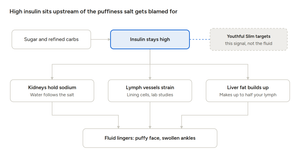
Put the three exhibits together and a pattern appears. High insulin tells your kidneys to hold sodium and water. Insulin resistance may strain the cells lining your lymph vessels. And your liver, the biggest lymph producer you have, is one of the organs insulin resistance affects most.
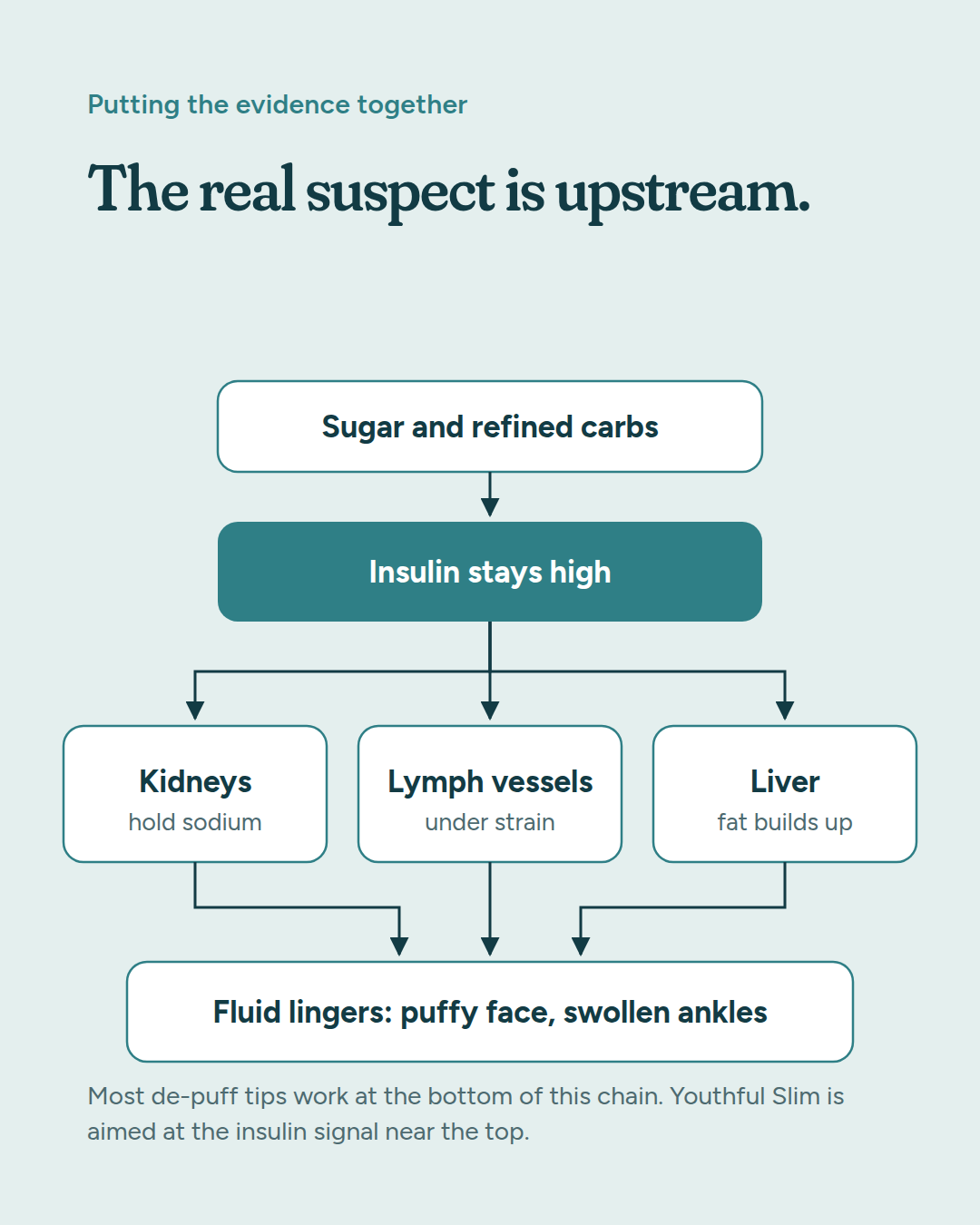
Most de-puff advice works at the bottom of this picture. Youthful Slim is aimed at the insulin signal near the top.
That's why I don't want you thinking only about your blood glucose number. Think about the whole system: insulin signaling, your liver, inflammation, and the structures that keep fluid moving. These processes are connected, and understanding those connections is how we get to root cause.
When swelling needs a doctor, not a lifestyle tweak. Puffiness and swollen ankles can also come from heart, kidney, liver, thyroid, or vein problems, and from some medications, including certain blood pressure drugs. Call your provider if swelling is new, getting worse, or affects one leg more than the other. Get urgent care if it comes with shortness of breath, chest pain, or a leg that is red, warm, and painful.
WHERE YOUTHFUL SLIM FITS: WORKING THE CASE FROM UPSTREAM
Most "de-puff" advice works downstream: drink more water, cut the salt, elevate your legs, dry brush. Those habits can help you feel better. But if high insulin is part of what keeps fluid on board, it makes sense to also work on the signal itself.
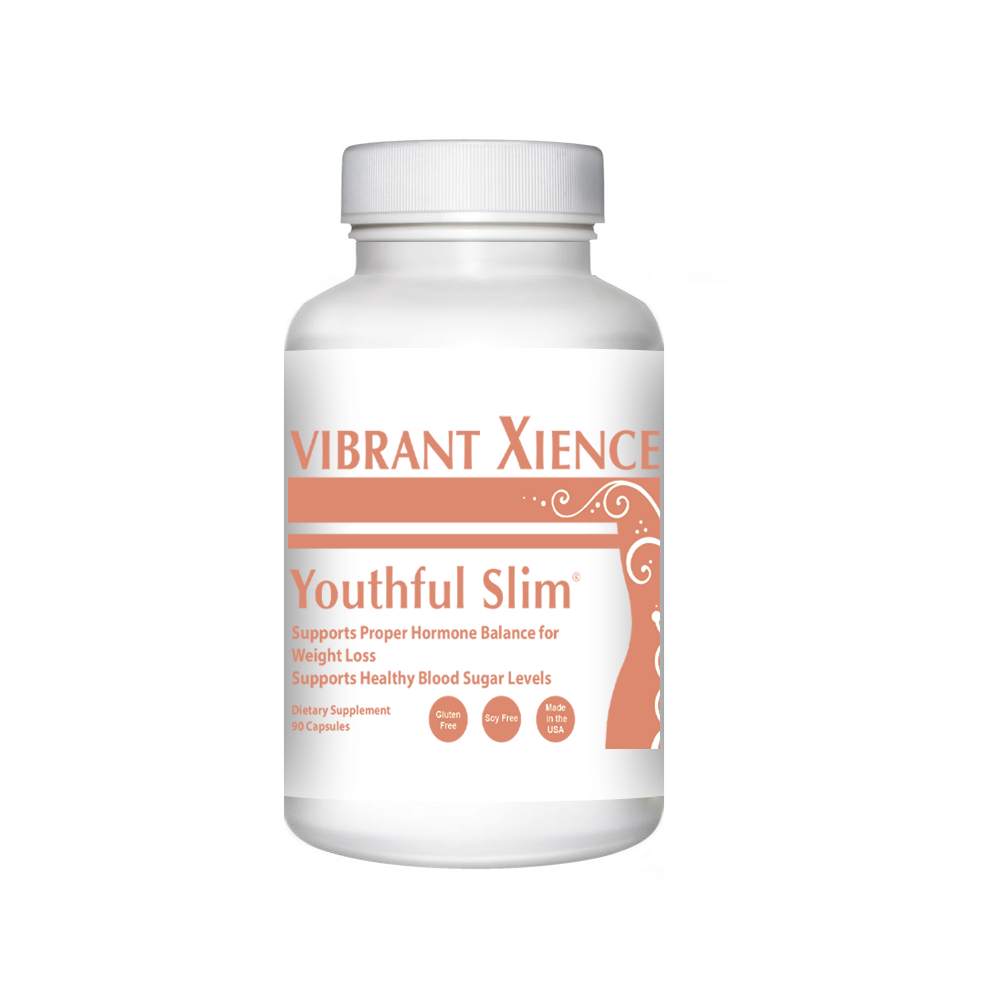
That's the side of the story I formulated Youthful Slim (https://vibrantxience.com/) for. It is not a diuretic or a "water pill," and it isn't intended to treat swelling, lymphatic conditions, or liver disease. It's designed to support healthy blood sugar, healthy insulin signaling, and fewer of the cravings that keep insulin spiking in the first place.
Berberine
Why it's in the formula: Supports healthy glucose metabolism and insulin sensitivity.
What the evidence looks like: The strongest of the three. A 2024 meta-analysis of randomized trials in people with fatty liver found improvements in liver enzymes, blood lipids, and HOMA-IR, with mainly mild digestive side effects. Many trials were small, so more high-quality research is still needed.
GTF Excell Chromium™
Why it's in the formula: Chromium plays a role in normal insulin signaling.
What the evidence looks like: Mixed. Some trials show modest improvements in glucose markers, others show little effect.
DNF-10
Why it's in the formula: Included to support appetite control and fewer carbohydrate cravings.
What the evidence looks like: Early stage. Published human research is limited, so think of it as supportive, not proven.
Think of Youthful Slim as one tool working alongside the basics: a lower glycemic way of eating, protein at every meal, daily movement (your calf muscles are a lymph pump), and good sleep.
Check with your provider first. Berberine can interact with medications, including those for blood sugar and blood pressure and some drugs processed by the liver. Youthful Slim is not recommended during pregnancy or breastfeeding.
WHAT TO ASK YOUR PROVIDER ABOUT
A glucose number won't show you this picture, and neither will fasting insulin on its own. Together, these markers give a much clearer view:
- HOMA-IR (fasting insulin + fasting glucose): how hard your pancreas works to keep glucose in range
- Triglyceride-to-HDL ratio: a practical insulin resistance signal from a standard lipid panel
- LPIR score: an insulin resistance score built from your lipoprotein profile
- ALT, AST, and GGT: whether your liver is under stress
- Liver ultrasound or FibroScan: whether fat is building up in your liver
- Kidney function and thyroid panel: rules out other common causes of swelling
REFERENCES
- Brosolo G, et al. Insulin Resistance and High Blood Pressure: Mechanistic Insight on the Role of the Kidney. Biomedicines, 2022. https://www.mdpi.com/2227-9059/10/10/2374
- Insulin and renal sodium handling: clinical implications. International Journal of Obesity, 1981. https://scholars.uthscsa.edu/en/publications/insulin-and-renal-sodium-handling-clinical-implications/
- Insulin resistance disrupts cell integrity, mitochondrial function and inflammatory signaling in lymphatic endothelium. 2018. https://pmc.ncbi.nlm.nih.gov/articles/PMC6170722/
- Cifarelli V, et al. Visceral obesity and insulin resistance associate with CD36 deletion in lymphatic endothelial cells. Nature Communications, 2021. https://doi.org/10.1038/s41467-021-23808-3
- Mouse study on obesity, nitrosative stress, and lymphatic injury. https://pmc.ncbi.nlm.nih.gov/articles/PMC7536739/
- Pupulim L, et al. Hepatic lymphatics: anatomy and related diseases. Abdominal Imaging, 2015. https://link.springer.com/doi/10.1007/s00261-015-0350-y
- Review of liver lymphatic anatomy and physiology. https://pmc.ncbi.nlm.nih.gov/articles/PMC7424986
- The clinical efficacy and safety of berberine in the treatment of non-alcoholic fatty liver disease: a meta-analysis and systematic review. Journal of Translational Medicine, 2024. https://pmc.ncbi.nlm.nih.gov/articles/PMC10908013/
DISCLOSURES: Dr. Emi formulated Youthful Slim, which is sold by Vibrant Xience, and she earns income from its sale. These statements have not been evaluated by the Food and Drug Administration. This product is not intended to diagnose, treat, cure, or prevent any disease. This article is for education only and is not a substitute for individual medical advice.