
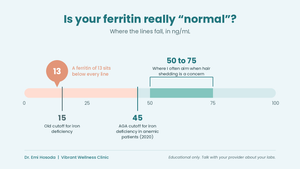
If I got my bloodwork back today and my ferritin was 13, I would not shrug it off. And I would not just grab an iron supplement and call it a day.
I know what you might be thinking: "But my lab says 13 is normal."
Let's talk about that, because "normal" on a lab report and "where your body feels its best" are not always the same number.
The ferritin cutoff has quietly moved
Ferritin is a protein that stores iron. Your ferritin level is essentially a snapshot of your iron reserves, the backup supply your body draws on when it needs more.
For years, a ferritin of 15 ng/mL was commonly used as the cutoff for iron deficiency. Below 15, you were deficient. Above it, you were fine.
But medicine has started recognizing that this number was probably missing a lot of iron deficiency.
In 2020, the American Gastroenterological Association (AGA) recommended using a ferritin below 45 ng/mL, rather than 15, to diagnose iron deficiency in people who are anemic. That is three times higher than the old cutoff.
And when it comes to symptoms like hair shedding, I often want to see ferritin even higher. Depending on the person and the rest of their labs, I am usually looking for something in the range of 50 to 75 ng/mL.
So a ferritin of 13? That sits below every one of these lines.
Why I care so much about this, especially in women
Low iron stores can show up in ways that are easy to blame on stress, a busy schedule, or just "getting older." You might notice:
- Exhaustion that sleep doesn't fix
- Anxiety that feels worse than usual
- Trouble concentrating
- Weakness or headaches
- Restless legs or other neurologic symptoms
- Hair shedding
That last one is one of the biggest complaints I hear from women.
Here's what makes it tricky: your ferritin may not be flagged as "low" on your lab report, and you can still be dealing with hair shedding. So in anyone struggling with hair loss, I look much more closely at their iron status.
To be honest about the research: studies linking ferritin to hair loss are mixed, and there isn't one agreed-upon "hair target" for ferritin. That's why I don't treat a single number in isolation. I look at it alongside your symptoms and the rest of your labs.
The first question isn't "which supplement?" It's "why?"
If my ferritin came back at 13, the very first thing I'd ask is: why is it this low?
There are really only three ways your iron stores drop:
- You're not getting enough iron from your food.
- You're not absorbing the iron you do take in.
- You're losing iron somewhere.
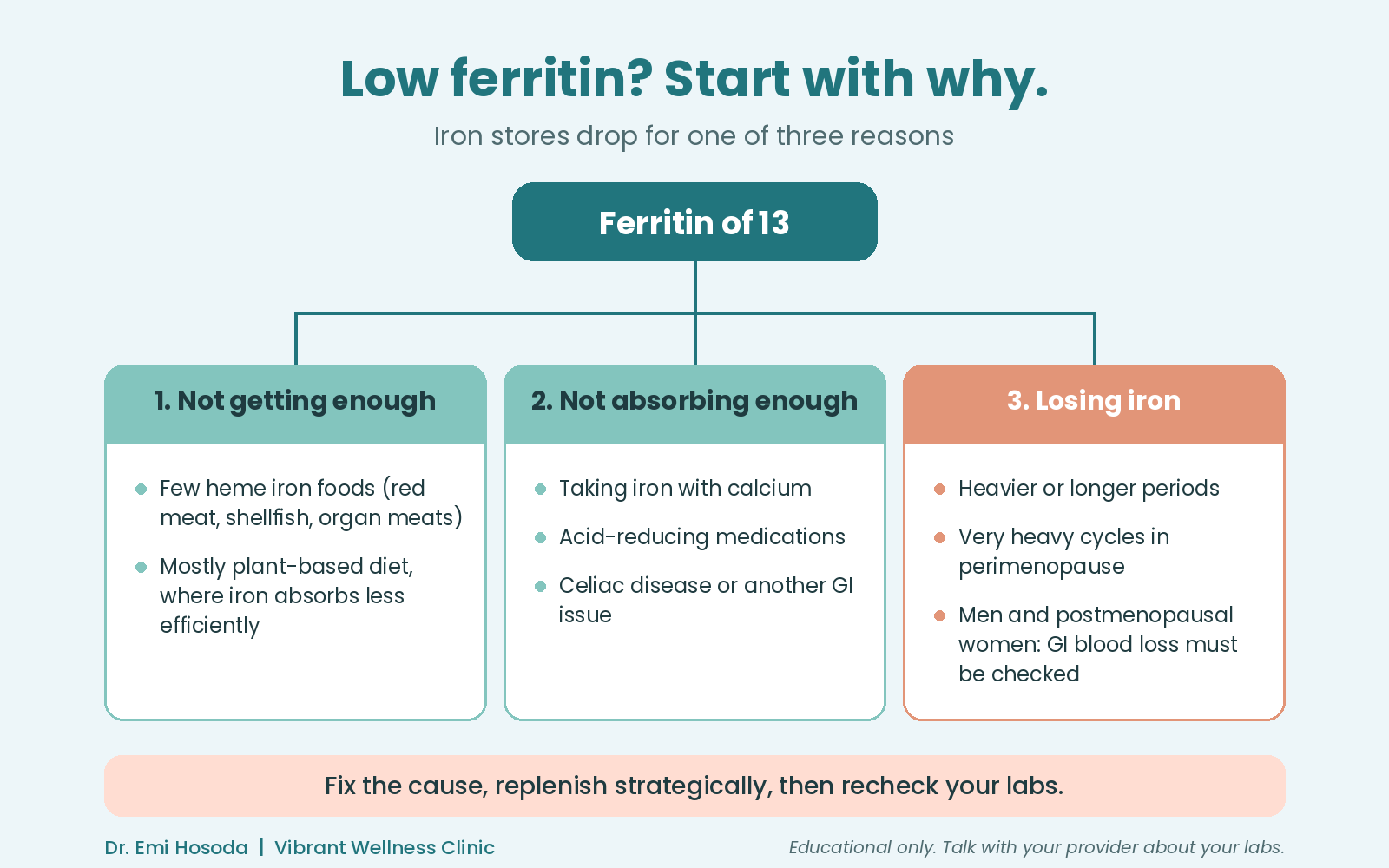
That third one matters more than most people realize.
If you're still menstruating
I'd look very carefully at your periods. Have they gotten heavier? Are you bleeding longer? Are you in perimenopause and suddenly having very heavy cycles every month?
You can take all the iron you want, but if you're losing it faster than you're replacing it, you'll keep ending up right back here.
If you're not menstruating
In men and postmenopausal women, unexplained iron-deficiency anemia needs to be taken seriously, because blood loss from the digestive tract has to be ruled out.
Current GI guidelines recommend evaluating these patients with both an upper endoscopy and a colonoscopy, rather than simply giving iron and hoping the numbers come up.
Then I'd look at my plate, and what's around my iron
If you eat animal products, prioritize foods rich in heme iron. It's the form your body generally absorbs most efficiently:
- Red meat
- Shellfish
- Organ meats, if you'll eat them
If most of your iron comes from plants, you need to be even more strategic. Plant-based non-heme iron isn't absorbed as efficiently.
Next, I'd look at what's happening around your iron. This is where a lot of people sabotage themselves without realizing it:
- Are you taking your iron with calcium?
- Are you on medications that reduce stomach acid, which can interfere with absorption?
- Are you actually absorbing what you put into your body?
Because swallowing an iron pill and absorbing that iron are two very different things.
Yes, I'd consider iron. Strategically.
After all of that, yes, I would consider supplemental iron. But more iron isn't automatically better.
When you take a dose of iron, your body raises a hormone called hepcidin. Hepcidin temporarily lowers your ability to absorb more iron, and it can stay elevated for about a day.
That's one reason why, depending on the person, once-daily or even every-other-day iron may make more sense than taking iron multiple times throughout the day. Small studies in iron-depleted women found that spacing doses out can improve how much iron is absorbed per dose.
The right dose, form, and schedule depend on you, so this is a conversation to have with your provider rather than a one-size-fits-all rule.
The form of iron matters too
When my patients need extra iron, the form I reach for is iron bisglycinate chelate, which is iron bound to the amino acid glycine. Compared with common forms like ferrous sulfate, it tends to be easier on the stomach, and some research suggests it may be better absorbed at lower doses.
That's why I formulated Iron Avail for my Vibrant Xience line. It uses a patented, fully reacted iron bisglycinate from Albion Laboratories, in a simple one-capsule-a-day format, and it's free of gluten, soy, dairy, and artificial additives.*
Iron Avail is designed to help supplement inadequate dietary iron and support healthy ferritin and hemoglobin levels.* It isn't a replacement for finding out why your ferritin is low. Use it alongside the steps above, under your provider's guidance.
Keep iron supplements out of reach of children. Accidental iron overdose is a leading cause of fatal poisoning in children under 6.
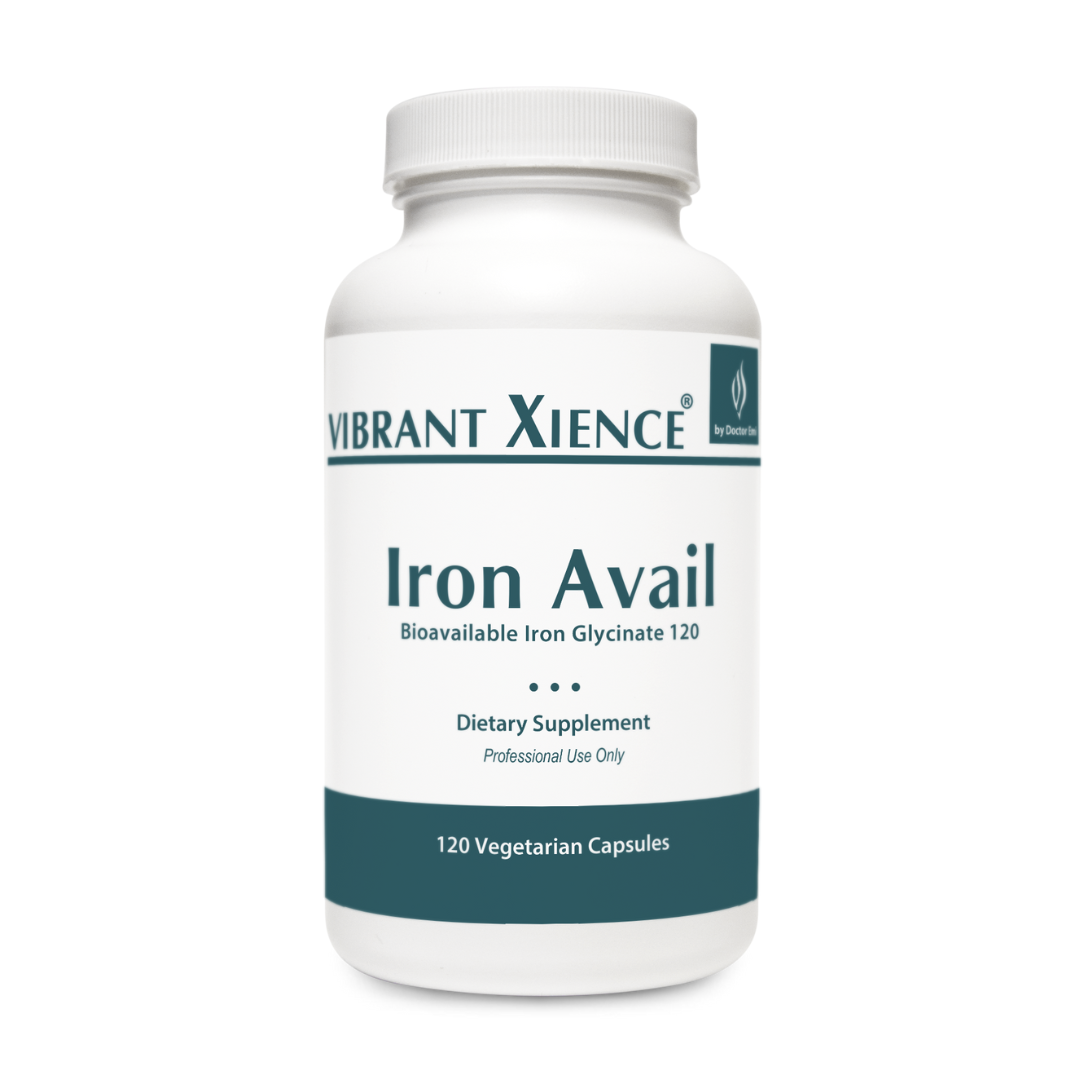
Iron Avail
Ferrous iron is reacted with glycine to form bis-glycinate chelate, a non-electrically charged compound that is totally nutritionally functional.
Then I'd recheck, and listen to what the numbers say
If I'm doing all of these things and my ferritin still isn't moving, that tells me something. I'd want to know:
- Am I still losing blood?
- Do I have an absorption problem?
- Could there be celiac disease or another GI issue?
- Is inflammation affecting my ferritin?
- What do the rest of my iron studies show?
- Am I someone who doesn't respond well to oral iron and needs a different approach?
The bottom line
Please don't look at a ferritin of 13 and think the whole solution is buying an iron supplement.
The more important question is: why did my iron stores get this low in the first place?
And low ferritin isn't the only ferritin problem I look for. A high ferritin can tell an entirely different story. I'll cover that in my next post.
This post is for educational purposes only and is not medical advice. Please talk with your healthcare provider before starting any supplement or making changes to your care.
*These statements have not been evaluated by the Food and Drug Administration. This product is not intended to diagnose, treat, cure, or prevent any disease.
Disclosure: Dr. Emi Hosoda is the founder of Vibrant Xience and has a financial interest in the products mentioned in this post.
References
- Ko CW, et al. AGA Clinical Practice Guidelines on the Gastrointestinal Evaluation of Iron Deficiency Anemia. Gastroenterology. 2020;159(3):1085-1094. Source of the ferritin below 45 ng/mL cutoff in anemic patients and the upper endoscopy plus colonoscopy recommendation. A formal guideline, though several recommendations rest on low-certainty evidence.
- Moretti D, et al. Oral iron supplements increase hepcidin and decrease iron absorption from daily or twice-daily doses in iron-depleted young women. Blood. 2015;126(17):1981-1989. Small isotope-labeled absorption study in young women.
- Stoffel NU, et al. Iron absorption from oral iron supplements given on consecutive versus alternate days and as single morning doses versus twice-daily split dosing in iron-depleted women. Lancet Haematology. 2017;4(11):e524-e533. Small randomized absorption study; measures absorption, not long-term symptom outcomes.
- Trost LB, Bergfeld WF, Calogeras E. The diagnosis and treatment of iron deficiency and its potential relationship to hair loss. Journal of the American Academy of Dermatology. 2006;54(5):824-844. Review noting the hair loss and ferritin evidence is mixed; the 50 to 75 ng/mL range reflects clinical judgment rather than an established standard.