Click this link to shop all my favorite clean-beauty favorites on my Amazon Storefront. These are all products that I use and pull out of my makeup bag over and over again, as well as my favorite glowy body oil.
I got a DM the other day that told me the "wet look" on my face distracts from my message.
I read it twice, because that glow isn't a mistake I need to fix. It's the exact look I'm going for, and there's a real reason I chose it.
The dewy glow has a name, and a history
The technique you're seeing is often credited to celebrity makeup artist Scott Barnes, who built J-Lo's signature glow decades ago and helped make "glass skin" and the dewy finish a mainstream standard rather than a trend. It's stuck around this long because of simple physics: dewy, luminous skin reflects light, while a flat matte finish absorbs it.
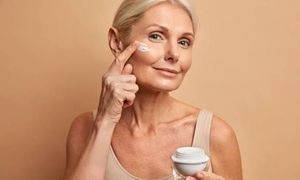
That distinction matters more the older we get. Reflected light softens the look of fine lines and texture. Absorbed light, the kind a matte finish creates, tends to sit inside every line and crease instead of bouncing off them, which can actually draw more attention to them. So if my skin looks "wet," that's the point. It's doing exactly what it's designed to do for a face like mine, or yours, at this stage of life.
But that DM got me thinking past makeup. Because the truth is, no amount of glow product fixes skin that's inflamed, oxidized, or under chronic chemical stress from the inside. If we're talking about looking younger longer, the conversation has to start underneath the glow, not just on top of it.
What's actually aging your skin
A huge amount of visible skin aging comes down to something called oxidative stress: an imbalance between the free radicals your skin is exposed to and the antioxidants available to neutralize them. Research on skin aging consistently points to reactive oxygen species (ROS) as a driver of collagen breakdown. Aged skin shows more fragmented, disorganized collagen than younger skin, and elevated ROS levels are associated with the enzymes that chew through collagen and elastin in the first place. Excessive UV exposure is the biggest external trigger, but it's not the only one.
This is where clean beauty and "limiting toxins" stop being a wellness buzzword and start being genuinely relevant to how fast you age.
Click this link to shop all my favorite clean-beauty favorites on my Amazon Storefront. These are all products that I use and pull out of my makeup bag over and over again, as well as my favorite glowy body oil.
Where clean beauty actually intersects with aging
Two ingredient categories worth knowing about:
Parabens. These preservatives show up in a huge share of lotions, shampoos, and personal care products. They've been identified by multiple international bodies, including the UN Environment Programme and Denmark's Centre on Endocrine Disruptors, as endocrine-disrupting or potentially endocrine-disrupting chemicals, meaning they can mimic estrogen and interfere with normal hormone signaling in the body.
Phthalates. Commonly used as fragrance carriers in perfumes and personal care products, phthalates are also classified as endocrine disruptors, and research has linked combined paraben and phthalate exposure to cellular stress in skin tissue.
I want to be honest about where the research stands, because I never want to overstate a finding to make a point. Much of the strongest data linking these chemicals to specific harms comes from animal studies at higher doses than typical human exposure, and human research is still catching up. But there's a genuinely interesting real-world study worth mentioning: researchers had one group of women switch to paraben-, phthalate-, and fragrance-free products for 28 days, then measured biological changes in breast tissue, blood, and urine before and after. That kind of before-and-after human data, imperfect as any single study is, is exactly the direction I want to see more research move in.
So my take isn't "these ingredients will definitely harm you." It's this: when the swap is easy (a different moisturizer, a fragrance-free lotion) and the theoretical downside is meaningful hormone disruption, that's a low-cost, high-logic decision. That's precision medicine in practice. Small, evidence-informed swaps, not fear, not perfection.
So, glow on
The wet look isn't a distraction from my message. It's actually a small illustration of it: the outside of your skin reflects what's happening on the inside, and both are worth paying attention to. Glowy, reflective skin looks younger because of how it interacts with light. Reducing your toxin load, one honest swap at a time, is one of the ways you help your skin actually behave younger, not just look like it for a photo.
I'll keep wearing the glow. And I'll keep chasing the research on how to help it be real, not just reflected.
Click this link to shop all my favorite clean-beauty favorites on my Amazon Storefront. These are all products that I use and pull out of my makeup bag over and over again, as well as my favorite glowy body oil.
This post is educational content, not a diagnosis, medical advice, or a guarantee of results. Talk to your provider before changing your skincare or supplement routine.